SPREADSHEET REPLACEMENT
Replace business-critical spreadsheets with software built for the job.
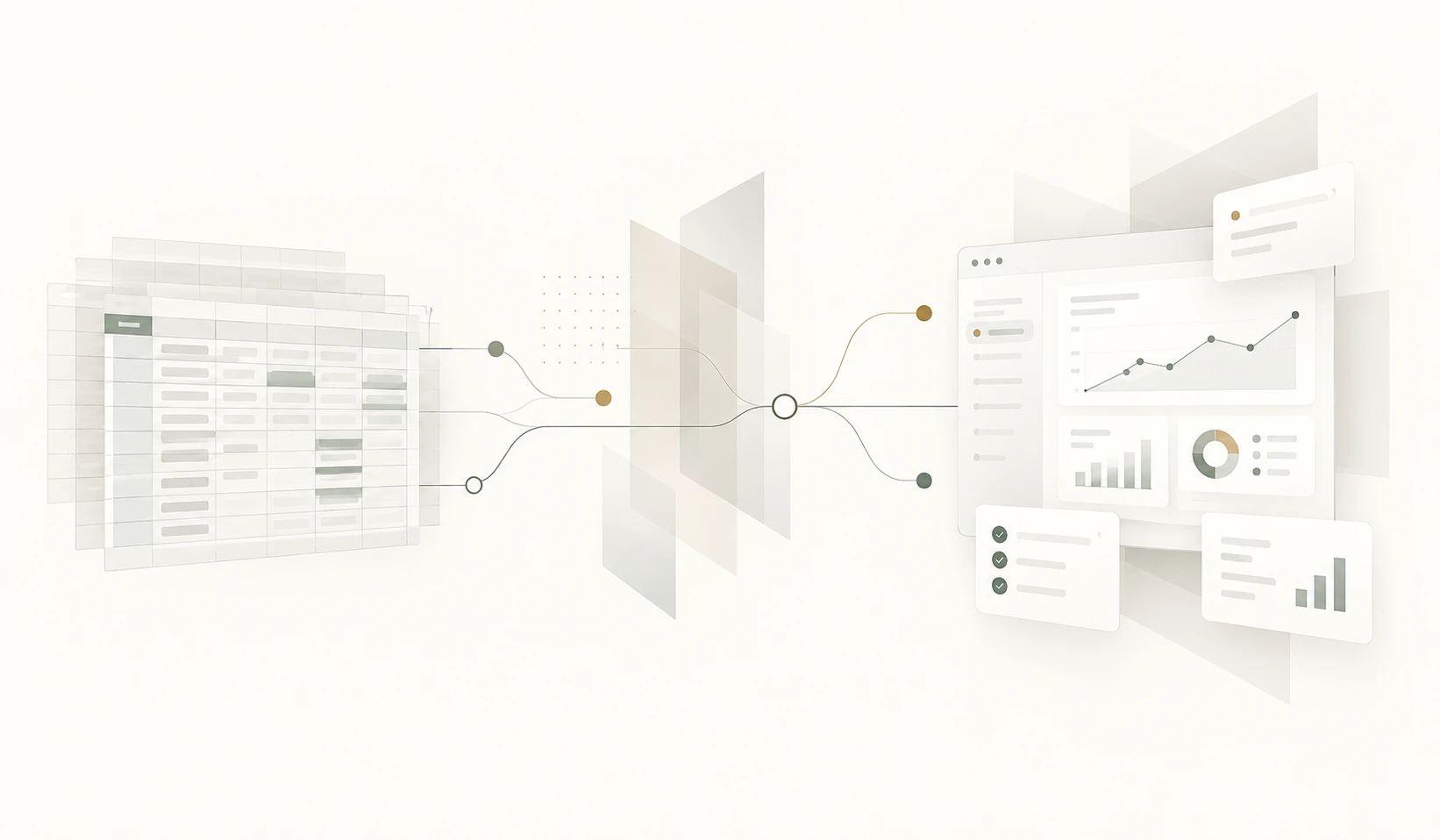
Spreadsheets are excellent tools, but they often become difficult to manage once they start carrying important business processes.
We replace complex Excel spreadsheets and manual workflows with secure, shared web applications that are easier to use, easier to control and better suited to day-to-day operations.
When a spreadsheet starts doing more than it was designed to do
Many business systems begin with a spreadsheet.
A simple file grows over time. More columns are added. Formulas become more complex. Several people need access. Copies start circulating by email. Macros appear. Reporting depends on one person knowing how everything works.
Eventually the spreadsheet is no longer just a document. It has become an important part of the business process.
That is usually the point where a purpose-built application begins to make sense.
Common spreadsheet problems
-
Multiple versions
Several copies of the same spreadsheet exist and nobody is completely sure which one contains the latest information.
-
Manual data entry
The same information is repeatedly copied between spreadsheets, emails and other business systems.
-
Fragile formulas
Complex formulas, links and macros make the process difficult to maintain and easy to break.
-
Limited collaboration
Several people need to work with the same data, but access, ownership and responsibility become difficult to manage.
-
Poor auditability
It is difficult to see who changed something, when it changed and why.
-
Difficult reporting
Management information requires manual preparation instead of being available when it is needed.
A system built around your existing process
Replacing a spreadsheet does not mean throwing away the process that already works.
We first understand what the spreadsheet is doing, who uses it, where the data comes from and what decisions depend on it.
We then design a web application that keeps the useful parts of the existing process while removing the limitations that make it difficult to manage.
-
Shared data
Everyone works with the same current information.
-
User roles and permissions
People see and change only the information relevant to their role.
-
Validation
Business rules can be applied automatically before incorrect data enters the system.
-
Workflow
Approvals, statuses, notifications and hand-offs can become part of the process instead of being managed separately.
-
Reporting
Reports and management information can be generated directly from live operational data.
-
Integration
The application can exchange information with existing systems, APIs and external services where required.
Not every spreadsheet should become an application
A spreadsheet may still be the right solution for a small, flexible task used by one or two people.
We normally recommend replacement when the spreadsheet has become operationally important, is used by several people, contains complex business rules or creates unnecessary manual work and risk.
The objective is not to replace Excel for the sake of technology. It is to remove a practical limitation in the business.
Processes that are often good candidates
- Quotations and pricing
- Sales and order tracking
- Project and job management
- Inventory and asset tracking
- Compliance and inspection records
- Claims and case management
- Scheduling and resource planning
- Financial or operational reporting
- Membership and customer records
- Approval workflows
From spreadsheet to working application
-
01 — Understand the process
We review the spreadsheet, the people who use it and the wider business process around it.
-
02 — Separate data from process
We identify the underlying data, business rules, calculations and workflow that have gradually become embedded in the file.
-
03 — Design the replacement
We define a practical application that supports the existing operation without recreating unnecessary spreadsheet complexity.
-
04 — Build and integrate
We develop the system and connect it to existing services or data sources where that provides real value.
-
05 — Introduce it carefully
Where appropriate, the existing spreadsheet can continue to operate while the new system is tested and introduced.
What changes after the spreadsheet
- One shared source of current information
- Less repetitive manual work
- Clearer responsibility and permissions
- Consistent application of business rules
- Better visibility across the process
- More reliable reporting
- A system that can evolve as the business changes
It does not have to become another isolated system
A spreadsheet often exists because information needs to move between systems that were never designed to work together.
Where useful, the replacement application can connect to existing databases, accounting systems, CRMs, APIs, payment services or other business software.
In many cases, removing the spreadsheet also removes the manual work of moving information between those systems.
Learn more about Software Integration →
Replacing the spreadsheet may only be part of the opportunity
Once the data and business rules are managed by a proper application, other repetitive steps can often be automated as well.
Notifications, document generation, approvals, status changes, scheduled tasks and integrations can become part of the same workflow.
Has a spreadsheet become too important to remain a spreadsheet?
Show us how it works today.
We can help you decide whether it should remain in Excel, be improved, or be replaced with a purpose-built business application.
No obligation. Start with the problem.